

解体工事が進められていた「旧香川県立体育館」が、保存活用に向けての“最後のチャンス”を迎えています(詳細はこちらの記事を→https://bunganet.tokyo/kagawastop/)。この機に、BUNGA NETでは緊急連載「旧香川県立体育館に思う──アーキテクトボイス50」を行います(発起人:田根剛、佐々木睦朗、北山恒、宮沢洋)。この建築や今回の経緯への思いを、1日1人組ずつアップしていきます。26人目は、MOUNT FUJI ARCHITECTS STUDIOの原田真宏氏です。冒頭の青字部分は編集部へのメッセージですが、原田氏の了解を得て、そこも含めて掲載しました。(ここまでBUNGA NET編集部)

この声明を誰に向かって書くか? が気になりました。
建築家が建築界に向けて書くのでは意味がないし、文化人に向けてでもこの段階では間接的に過ぎます。ではあの体育館を所轄する行政に対して書けば良いのかというとそれでも不足な気がします。建築の保存とはコミュニティーの記憶の維持コストの問題だからです。コミュニティーの成員である一般の方々に向けて記憶媒体としての建築の価値を、専門家としてわかりやすく伝えることで、その維持コストの支出に対して賛同を得なければならず、これがミッションだと考えました。以下は、そんな意図で準備したものです。
――――――――
今回のような“建築の保存問題”なんていうと、なんだか大ごとで自分の生活から遠い、ちょっと高尚(?)で学術的(?)な、大切なんだろうけれど自分ごととはちょっと思えない、、そんな方々が大多数なんだろうと思います。無理もないです。社会にはもっと差し迫った問題があるだろう?、、そうかもしれません。
この文章を読んでいるということは、今、休憩中でしょうか。仕事や家事の合間か、食後の一服中かもしれないですね。手元にはコーヒーかお茶、ひょっとしたらお酒が入ったコップがありませんか? コップを片手に、少しお付き合いください。
というのも、“建築”は“器(うつわ)”に、よくたとえられるんです。
「器の用途は液体を入れることだから、空洞の部分が器の本質だよ。建築も同じで、何もない虚な部分、つまり用をなす空間が建築の本体なんだ。セトモノだろうとコンクリートだろうと、空間の側(ガワ)が何でどうできているかなんて瑣末なことさ」
と、これは老子を引いた言葉のようですが、建築学科の新入生に対してインテリぶった先輩がカマす典型的なセリフです(笑)
でも、本当にそうでしょうかね?
その手元のコップがペカペカのプラコップでも、使い慣れた黄瀬戸の茶碗でも、コーヒーを飲む経験は同じですか?両方、例えば180ml入るんだったら同じ?
そんなことはないでしょう。
僕の場合、このザラッとした黄瀬戸の茶碗はある人から譲り受けたものです。飲み口の凹みは、十数年前の徹夜明けに洗っている時、手を滑らせてできたもので、唇の触感がそれを思い出させます。厚めのセラミックを通して手から伝わる温かみと共に、それらの記憶が総合的なコーヒーを味わう体験を作ってくれているのです。この器は180ml液体が入るだけでなく、記憶の再生装置としての役割も果たしている。けれどプラコップにはその機能はありません。
さて、話を建築に戻しましょう。
“用途”だけのことを考えれば、安いプラコップのような側(ガワ)としての建物で事は足ります。でも、その生活の“経験”が豊かかどうか、が問われるのならば話は別です。先の器が個人の記憶媒体としての価値を持っていたように、建築はコミュニティーの記憶媒体としての機能を持っています。それが単なる用途〜今回の場合では運動〜を、それ以上の社会的な価値に転じてくれるのです。
今回は構造を含めて「用途を果たせなくなったことが問題なんだ」と、言われています。器でも水が漏れたらアウトです。そんな時は金継ぎをしますね。その傷や修繕の痕も含めて記憶なんです。建築でも金継ぎは十分可能です。僕がかつていたバルセロナでは、金継ぎ的な修繕をしていない建築を探す方が難しいほどでした。それは市民の皆が、建築を失うことは自分たちの記憶を失うことだと認め、コミュニティーの記憶の維持コストとして、建築の維持コストを認めていたからです。時には用途さえ変えながら(良い建築は用途を呼び寄せます)、新しい修繕のデザインを加えることで、記憶媒体としての建築を次の世代に引き継いでいるのです。
さて、皆さんはペカペカのプラコップが立ち並ぶような、記憶喪失の街で暮らしたいでしょうか?
あの船のような建築は、今後、いくらお金と時間を掛けても二度と手にいれることはできないでしょう。物理的に、だけでなく、皆さんの記憶的にも、です。
証拠保全として数週間延命された「船の体育館」は、まさに皆さんがそこにいた証拠です。ことは差し迫っています。
あの船に金継ぎを施して、次世代に引き渡してみませんか?
原田真宏/建築家、MOUNT FUJI ARCHITECTS STUDIO主宰、芝浦工業大学教授
プロフィルはこちら→https://www.fuji-studio.jp/profile.html
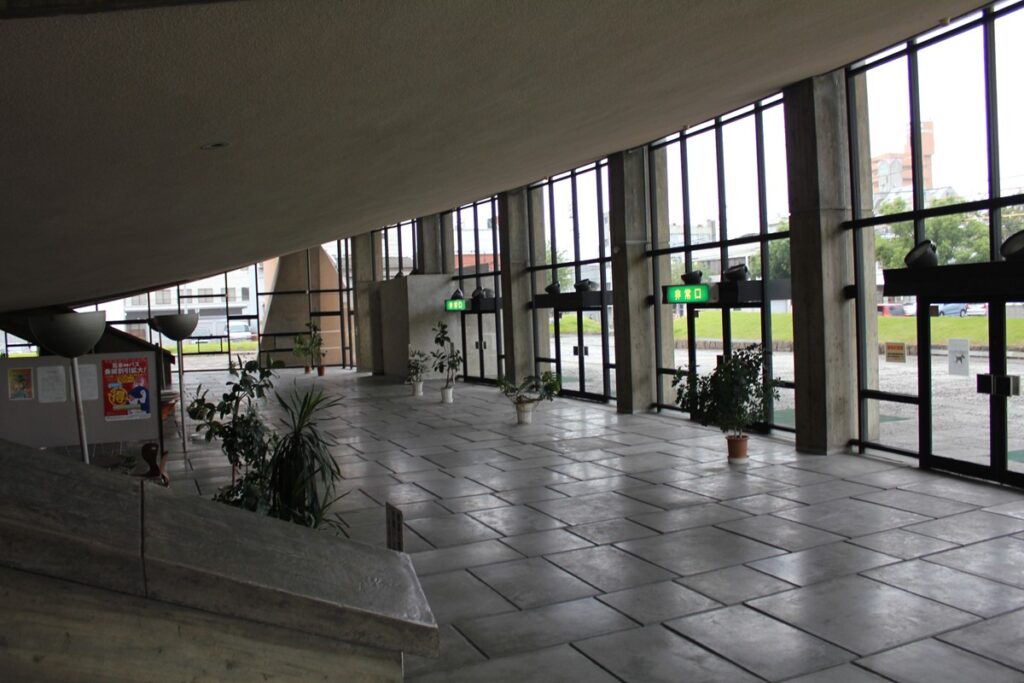 かつてのエントランスホール(写真:宮沢洋)
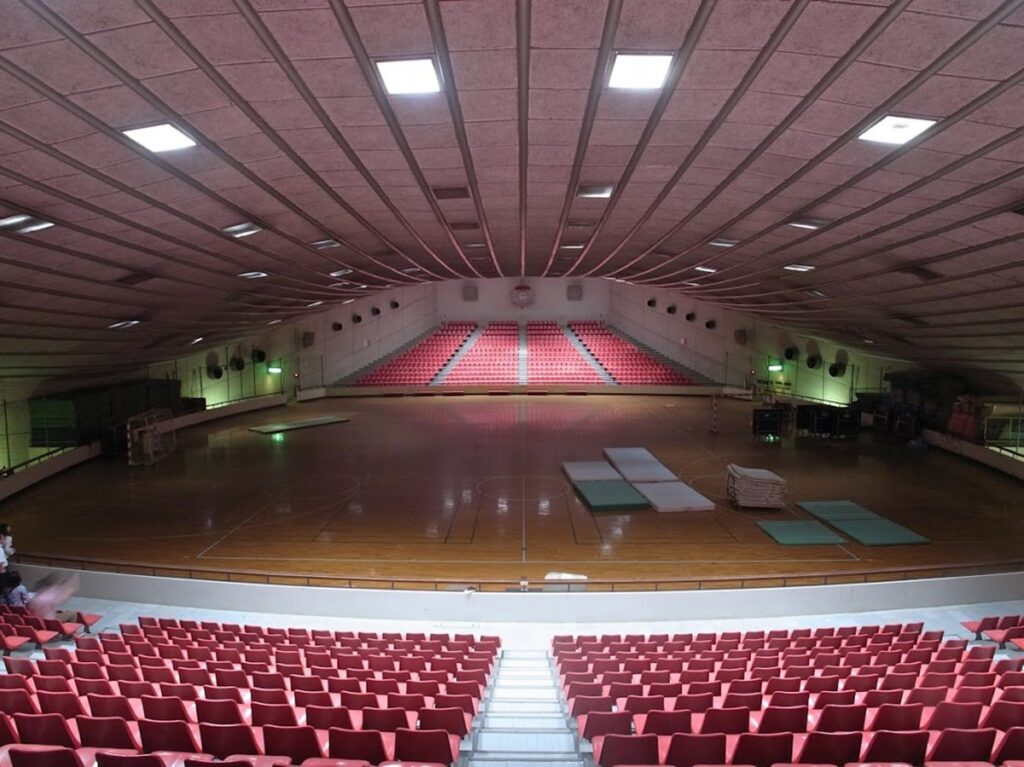 かつての体育館内(写真:旧香川県立体育館再生委員会)
I found myself wondering: To whom should this statement be addressed?
It would be meaningless for an architect to write to the architectural community, and even addressing cultural figures at this stage would be too indirect. But even if I were to write to the government agency responsible for that gymnasium, I feel that would still be insufficient. This is because the preservation of architecture is fundamentally a matter of the cost of maintaining a community’s memory. I believed my mission was to gain support for the expenditure required to cover those maintenance costs by clearly communicating—as an expert—the value of architecture as a medium of memory to the general public, who are members of that community. The following is what I prepared with that intention in mind.
――――――――
When people hear about “architectural preservation issues” like this one, I imagine the majority of them think it sounds like a big deal—something distant from their daily lives, a bit lofty (?) and academic (?)—something that’s important, sure, but not something they can quite relate to personally. And that’s understandable. Aren’t there more pressing issues in society? …Perhaps so.
If you’re reading this, you’re probably taking a break right now. Maybe you’re taking a breather between work or household chores, or enjoying a moment of relaxation after a meal. Do you have a cup of coffee or tea—or perhaps even a glass of alcohol—within reach? With that cup in hand, please bear with me for a moment.
You see, “architecture” is often likened to a “vessel.”
“Since the purpose of a vessel is to hold liquid, its hollow interior is the essence of the vessel. Architecture is the same—the empty, void part, that is, the functional space, is the essence of architecture. Whether it’s pottery or concrete, what the outer shell of the space is made of is a trivial matter.”
Now, this might sound like a quote from Laozi, but it’s actually a typical line that a know-it-all upperclassman spouts to freshmen in the architecture department (lol).
But is that really true?
Whether the cup in your hand is a shiny plastic one or a well-worn Kise-to tea bowl, is the experience of drinking coffee the same? If both hold, say, 180 ml, are they the same?
Of course not.
In my case, I received this rough-textured Kise-to tea bowl as a gift from someone. The indentation on the rim was caused when my hand slipped while washing it after an all-nighter more than a decade ago, and the sensation against my lips brings that memory back. Along with the warmth transmitted from my hand through the thick ceramic, those memories contribute to the overall experience of savoring my coffee. This bowl doesn’t just hold 180 ml of liquid; it also serves as a device for rekindling memories. A plastic cup, however, lacks that function.
Now, let’s return to the topic of architecture.
If we consider only “functionality,” a building that serves merely as a shell—like a cheap plastic cup—would suffice. But if the question is whether the “experience” of daily life is enriching, that’s a different story. Just as the cup mentioned earlier held value as a medium for personal memories, architecture functions as a medium for community memories. It transforms mere functionality—in this case, sports—into something with greater social value.
In this instance, it’s been said that “the problem is that it can no longer fulfill its intended function,” including the structure itself. Even with a vessel, if it leaks, it’s a goner. In such cases, we perform kintsugi, don’t we? Those cracks and traces of repair are part of the memory. Kintsugi is entirely possible with architecture as well. In Barcelona, where I used to live, it was harder to find a building that hadn’t undergone kintsugi-style repairs. This was because the citizens recognized that losing a building meant losing their own memories, and they accepted the cost of maintaining the architecture as the cost of preserving the community’s memory. Sometimes even by changing its use (good architecture attracts new uses), and by adding new design elements to the repairs, we pass on architecture—as a medium of memory—to the next generation.
Now, would you want to live in a city suffering from amnesia, lined with rows of shiny plastic cups?
That ship-like building will likely never be recovered again, no matter how much money and time we invest in the future. Not just physically, but in your memories as well.
The “Ship Gymnasium,” whose demolition was postponed for a few weeks to preserve evidence, is proof that you were all there. The situation is urgent.
Why don’t we repair that ship with kintsugi and pass it on to the next generation?
Masahiro Harada / Architect, Director of MOUNT FUJI ARCHITECTS STUDIO, Professor at Shibaura Institute of Technology
パートナーの原田麻魚氏のコメントはこちら↓
Mao Harada/原田麻魚/「『誰かの決定』にならないために」/旧香川県立体育館に思う27
一覧ページはこちら↓
