
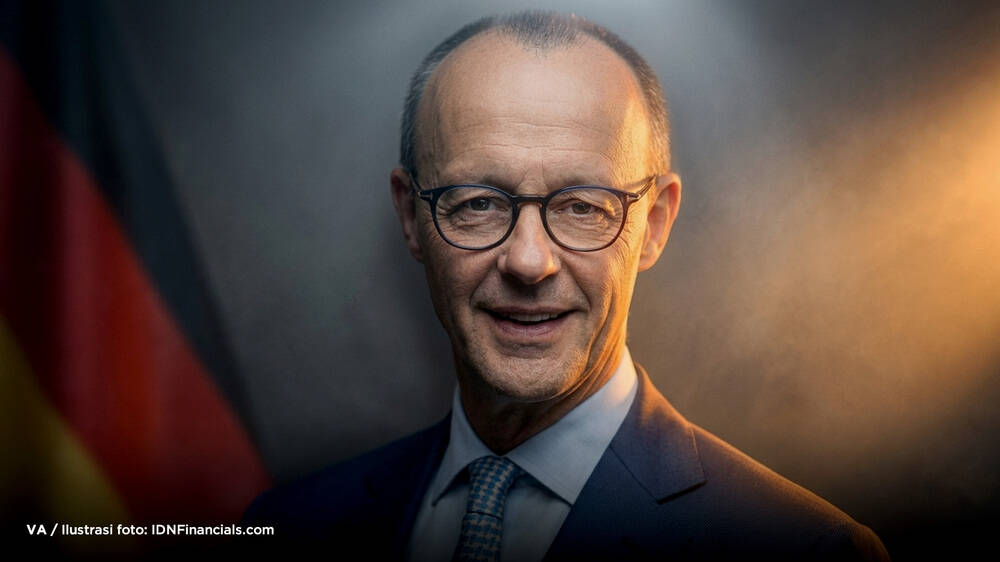
JAKARTA – German Chancellor Friedrich Merz has stressed that his country should not shy away from discussions on increasing defence spending, responding to criticism from US President Donald Trump who described Germany’s military expenditure record over the years as “ridiculous”.
As reported by Reuters, Merz made the statement ahead of next week’s NATO leaders’ meeting in Ankara, where European nations are seeking to demonstrate their commitment to strengthening regional defence while easing tensions with Washington over several geopolitical issues, including Iran and Greenland.
“Germany has doubled its defence budget within four years. This is the biggest effort we have ever made to strengthen our defence capabilities. In this regard, we do not need to feel intimidated by anyone,” Merz told reporters.
He added, “We will present this with all humility, and we present it as the largest EU member state bearing responsibility in Europe.”
Merz emphasised that Germany is undertaking the largest defence budget increase in its modern history. The government is targeting a doubling of military spending within four years as part of efforts to strengthen national defence capabilities and meet NATO commitments.
Earlier, Trump again criticised NATO members’ contributions to defence budgets via his Truth Social platform. He argued that the United States has long borne an unequal burden compared with its allies.
In one post, Trump said Germany’s defence spending between 2014 and 2025 was far lower than that of the United States and several other NATO members, calling the situation “Ridiculous!”
At last year’s NATO summit in The Hague, alliance leaders agreed on a new defence spending target of 3.5% of gross domestic product (GDP) for core defence needs such as weapons procurement and military strength, to be achieved no later than 2035. This target is higher than the previous 2% of GDP benchmark.
Merz said Germany is committed to meeting the target earlier than agreed.
“We also take the Russian threat very seriously, and we are arming ourselves to face it,” Merz said during a visit by Baltic leaders in Berlin.
He added, “We will reach the 3.5% benchmark set in The Hague by early 2029, well ahead of the agreed deadline.”
Relations between the United States and its European allies have come under strain over the past year. Tensions have been fuelled by several of Trump’s policies, including threats to take over Greenland from Denmark, a NATO member, and the decision to launch military operations against Iran without prior consultation with European nations.
The conflict has also affected Trump’s personal relations with several European leaders, including Merz, who previously said the United States had suffered “humiliation” in its confrontation with Iran. (DH/LM)
as a preferred source on Google