
PROFILE
After working as a buyer for “ÉDIFICE” and “L’ECHOPPE,” she is currently active as the creative director of her own brand, “FOUNDOUR,” and as the owner of “BOUTIQUE” in Gaienmae. In addition, she demonstrates her expertise in a wide range of fields as a fashion director and will serve as the Japanese concept developer for 〈Felisi〉 starting in 2025.
Italy is viewed through a filter of beauty.
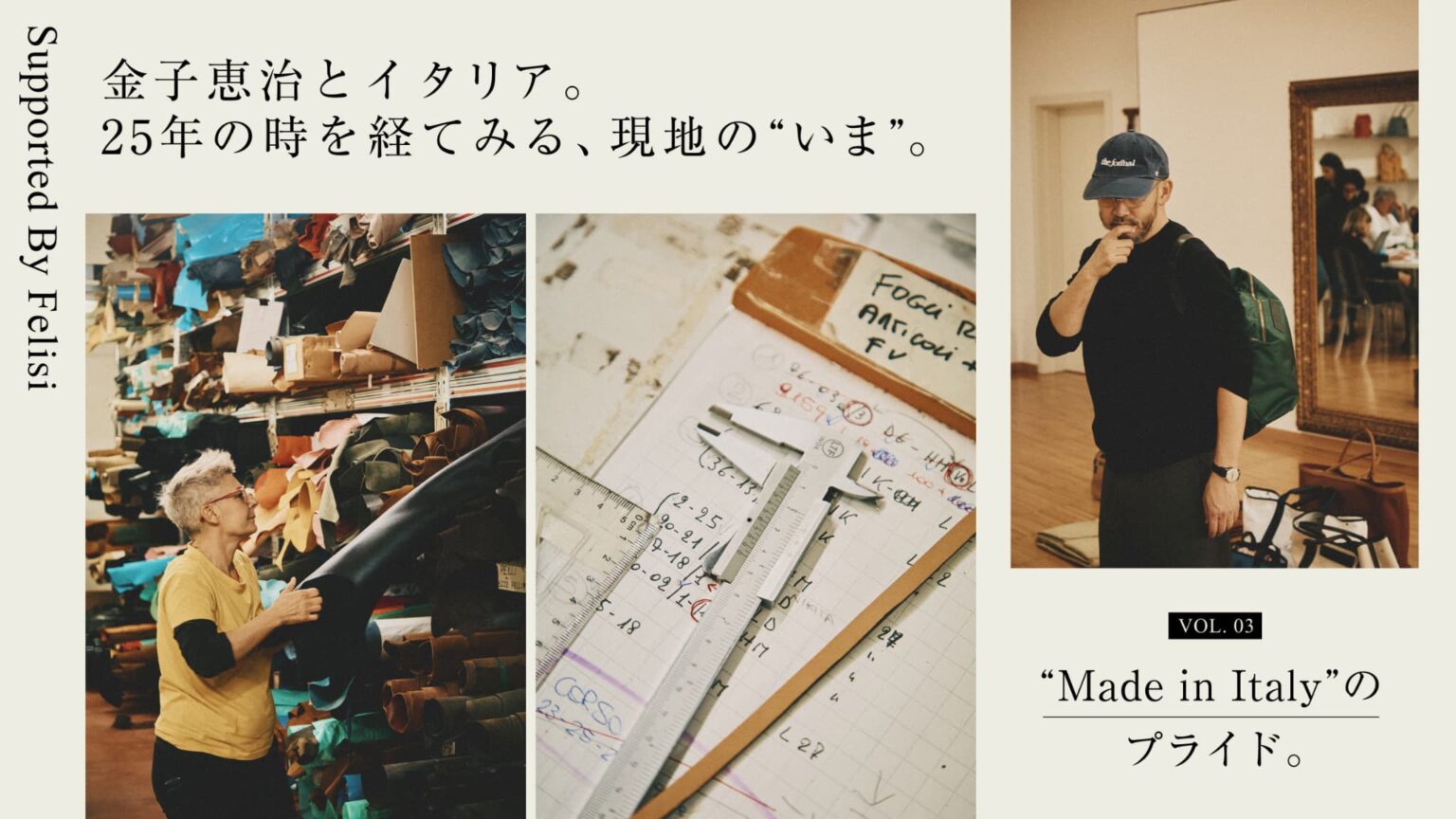
After visiting Italy for the first time in 25 years, Ms. Kaneko says that “Italian” items—especially Ferragamo bags—have become a more common part of her daily life. Having encountered items from various countries, what exactly is the appeal of “Made in Italy” that she can truly appreciate when she holds them in her hands?
—Mr. Kaneko, what kinds of “Made in Italy” items have you encountered so far?
Kaneko:The very first time I picked one up was back when I was working at “Edifice.” At the time, the “Classico Italiano” trend was in full swing, and I owned high-quality, hand-sewn shirts—something I’d never encountered before—as well as shoes with exceptionally stiff Norwegian-style edges. With each item, I felt as though it had taken on a special aura simply by being filtered through the Italian lens.
—When I think of Mr. Kaneko, I get the impression that he’s strongly influenced by American culture. Is that really not the case at all?
Kaneko:Both the United States and Italy have a strong tradition of craftsmanship, but even when it comes to making the same shirt, for example, the Italian version always turns out more elegant. While the United States tends to prioritize efficiency in its manufacturing, I feel like in Italy, every item is filtered through a lens of beauty and similar considerations.
—It’s kind of alluring, I guess.
Kaneko:That’s true. Italian fabrics really do have a beautiful finish. On the other hand, American fabrics are made with the assumption that they’ll be washed repeatedly, and that actually adds to their charm.
—Have you picked up any “Made in Italy” items recently?
Kaneko:This is the white jacket I wore on my business trip to Italy in June. It’s also hand-sewn using the 100% method—it really feels like a masterpiece of craftsmanship. I tried on all sorts of jackets in preparation for the trip, but in the end, this one turned out to be the best.
—What did you like about it?
Kaneko:It’s incredibly soft and fluffy. When I slip it on and look in the mirror, I get the feeling that my figure has improved without me even realizing it. It doesn’t draw attention to my sloping shoulders, but rather gives the shoulder line a natural, full look. It hugs the slope of my shoulders, smoothing out the contours of my upper body. Because it looks so natural, it doesn’t feel forced at all.
—It’s less about hiding the bad parts and more about “making it look good.”
Kaneko:That’s exactly how it is. British jackets are padded, giving the impression that they create a specific silhouette regardless of the wearer’s body type. In contrast, Italian jackets are tailored to flatter the wearer’s figure.
When I went to Milan and stopped by the store that sells these jackets, the designer happened to be there, and he was incredibly muscular. I figured he must be someone who’s very conscious of “showcasing” his body. It somehow made perfect sense to me that this was reflected in the jackets as well.
On the other hand, I feel like there’s something similar about *Ferragamo* bags as well.
Kaneko:Their products are incredibly functional and crafted with a deep respect for tradition, but you can tell they’re also designed with the intention of looking cool and beautiful when someone holds them. I’m really drawn to that approach.