
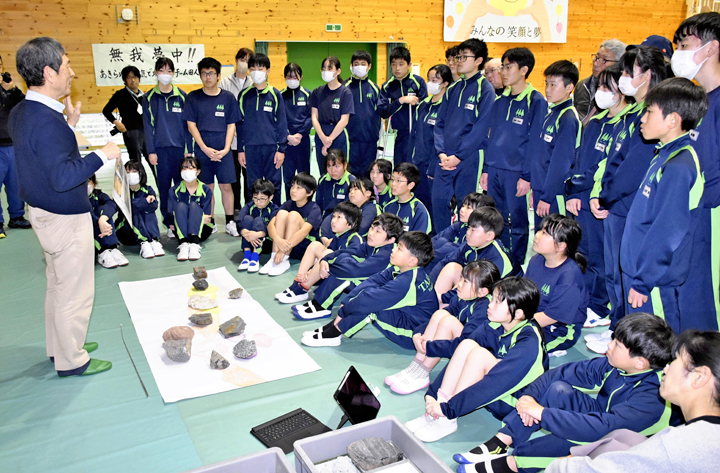
Students listen to a lecture by Yojiro Taketani, left, a former curator of the Fukushima Museum, in Iwaki, Fukushima Prefecture, on April 10.(4月10日、福島県いわき市で、生徒たちが福島県立博物館の元学芸員の竹谷陽二郎さん(左)の講演に耳を傾けている)
IWAKI, Fukushima – April 11 marked 15 years since a massive aftershock struck in the southwestern part of Iwaki, Fukushima Prefecture. The quake, which came just a month after the Great East Japan Earthquake, measured a lower 6 on the Japanese seismic scale of 7.
4月11日は、福島県いわき市の南西部で発生した大規模な余震から15年目にあたる日だった。東日本大震災のわずか1か月後に発生したこの地震は、7段階ある日本の震度のうち震度6弱を記録した。
In Iwaki’s Tabito district, where four people died in a landslide triggered by the aftershock, the community has sought to pass memories of the disaster and the lessons learned on to the next generation.
余震による土砂崩れで4人が死亡したいわき市田人地区では、地域住民が災害の記憶とそこから得られた教訓を次世代に伝えようとしている。
As part of such efforts, an expert gave a lecture on April 10 that helped local elementary and junior high school students deepen their understanding of what occurred, and the mechanisms behind the aftershock, on April11.
こうした取り組みの一環として、4月10日には専門家による講演が行われ、地元の小中学生が4月11日に発生した余震のメカニズムやその原因について理解を深めるのに役立った。
The local efforts are being run by a council that promotes the Tabito district.
この地域における取り組みは、田人地区の振興を目的とする評議会によって運営されている。
Since 2013, the council has planted ginkgo trees along the Itozawa Fault, which runs through the district and is believed to have triggered the aftershock. And since 2024, the council has been working on a project for passing on the lessons of the disaster to local children born after the quake.
評議会は2013年から、田人地区を通り、余震を引き起こしたと考えられている井戸沢断層に沿ってイチョウの木を植えてきた。そして2024年からは、震災後に生まれた地元の子供たちに災害の教訓を伝えるプロジェクトに取り組んできた。
The recent lecture was attended by about 40 students, ranging from third graders at Tabito Elementary School to third-year students at Tabito Junior High School. Yojiro Taketani, a former curator of the Fukushima Museum, delivered the lecture, which was titled “The Earth’s Movements, Analyzed Through Faults.”
先日開催された講演会には、田人小学校の3年生から田人中学校の3年生まで約40人が参加した。福島県立博物館の元学芸員の竹谷陽二郎さんが、「断層を通して見る地球の動き」と題して講演した。
Using models, Taketani explained the principles behind fault movements, and he also presented a soil peel specimen from the Itozawa Fault that he made himself.
竹谷さんは模型を用いて断層が動く原理を解説し、自身が作成した井戸沢断層の土壌の剥離標本を披露した。
”Through research, we can predict, to a certain extent, a future earthquake,” he said. “What’s important is that you have an appropriate fear of disasters.”
「研究によって、将来の地震をある程度は予測できる」と彼は述べた。「重要なのは、災害に対する適切な恐怖心を持つことだ」
Ibuki Tachi, a sixth grader at Tabito Elementary School, said: “I learned about how a fault works for the first time, which was really scary. Even if a big earthquake occurs, I want to be able to act with a cool head.”
( Translated by The Japan News )
田人小6年生の舘いぶきさんは、「断層の仕組みを初めて学び、とても怖いと感じた。大きな地震が起きても、冷静に対応できるようになりたい」と話した。
【 2026年4月11日付・福島民友新聞掲載 】
この記事をSNSで伝える: