
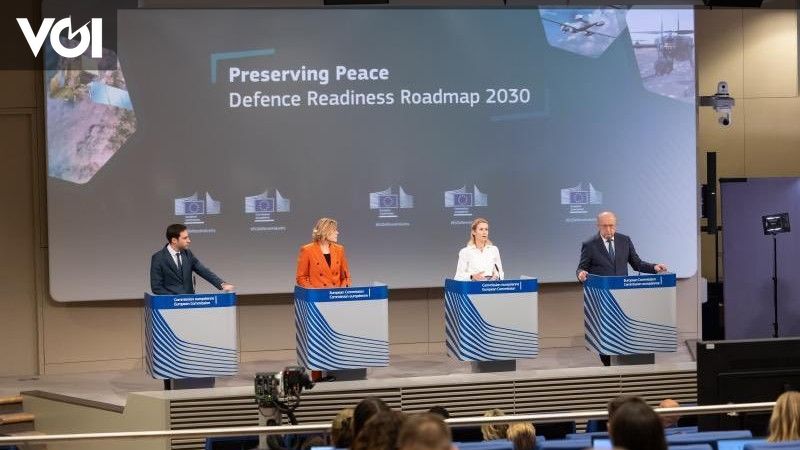
JAKARTA – The European Commission on Thursday proposed four leading European defense projects, including an anti-drone system and plans to strengthen the eastern border, as part of efforts to prepare the continent to defend itself by 2030.
The proposal, in a “road map” of defense policy, reflects fears sparked by the war in Ukraine that Russia may be attacking EU members in the years to come, and US President Donald Trump calls for Europe to do more for its own safety.
“The danger will not be lost even when the war in Ukraine ends. Obviously we need to strengthen our defenses against Russia,” said Head of EU Foreign Policy, Kaja Kallas in a joint press conference.
The commission said the two “seeds” were urgent – the European Drone Defense Initiative, previously known as the “drone wall”, and Eastern Flank Watch, which aims to “strengthen the eastern border of the European Union on land, air and sea”.
The commission said the two projects are expected to have an initial capacity by the end of next year. The drone project is expected to be fully operational a year later and “wings surveillance” is expected to reach that status by the end of 2028.
The commission also proposed European Air Shields, to defend against missiles and other air threats, as well as European Space Shields, to protect European space assets and services.
Leaders from 27 governments of EU member countries will decide whether to support the flagship proposal and agree on who runs the project that will get the green light.
Meanwhile, Ukrainian Defense Minister Denys Shmyhal praised the plan as “a turning point in European security thinking, a plan to maintain peace through power.”
In a tweet on X Shmyhal said the Ukrainian military “is now an integral part of Europe’s collective security.”
This flagship program is a test for the EU’s ambition to play a bigger role in Europe’s defense which is traditionally the responsibility of the national government and the NATO military alliance.
Commission officials said the proposal was based on NATO’s own capabilities targets and that the EU government would be the driving force in managing these projects.
The European Defense Commissioner, Andrius Kubilius, called the roadmap a “big plan for implementation, with a clear schedule, purpose, and reporting obligations”.


“That’s why we can refer to today as the day of implementation – or the Day-H for implementation,” he said.
The Commission has not set a price for these projects. Kubilus said EU members must first agree on project details before the costs can be estimated.
He said EU countries could use the national defense budget, which has increased rapidly in recent years, and funding such as the EU SAFE loan scheme worth 150 billion euros for defense projects, launched this year.
The English, Chinese, Japanese, Arabic, and French versions are automatically generated by the AI. So there may still be inaccuracies in translating, please always see Indonesian as our main language.
(system supported by DigitalSiber.id)