
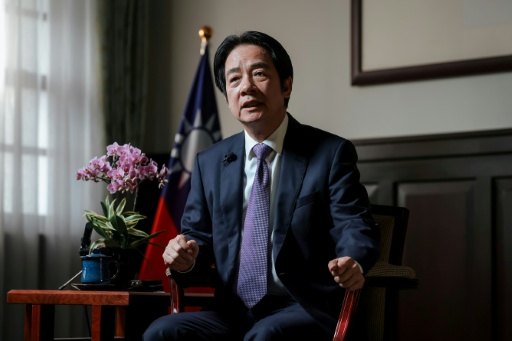
Taiwanese President Lai Ching-te warned that countries in the region would be China’s next targets should Beijing seize the democratic island, as he insisted on the need for Taiwan to dramatically shore up its defences.
Speaking to AFP in his first interview with a global news agency since taking office in May 2024, Lai said he was confident parliament will approve an additional $40 billion budget to fund crucial defence purchases, including weapons from the United States.
China’s President Xi Jinping has warned Washington against selling weapons to Taiwan, but Lai said the United States will stand by Taiwan and will not need to use it as a bargaining chip with Beijing.
Beijing condemned Lai’s remarks, calling him a peace disruptor, crisis creator, and war instigator.
Seeking independence through external means and resisting reunification by force is like an ant trying to shake a tree — doomed to failure, China’s foreign ministry spokesman Lin Jian told a regular briefing.
China claims Taiwan is part of its territory and has threatened to use force to bring the self-governed island under its control.
Lai said if China were to take Taiwan, Beijing would become more aggressive, undermining peace and stability in the Indo-Pacific and the rules-based international order.
If Taiwan were annexed by China, China’s expansionist ambitions would not stop there, Lai told AFP during an exclusive interview on Tuesday at the Presidential Office Building in Taipei.
The next countries under threat would be Japan, the Philippines, and others in the Indo-Pacific region, with repercussions eventually reaching the Americas and Europe, he said.
– ‘Peace-building effort’ –
Taiwan sees its location at the centre of Asia-Pacific’s so-called first island chain, which stretches from Japan to the Philippines, as critical to regional security and international trade.
China has competing territorial claims with Japan and the Philippines, while the Taiwan Strait is a major artery for global shipping.
Japanese Prime Minister Sanae Takaichi, whose country hosts several US bases and around 60,000 American troops, suggested in November that Tokyo could intervene militarily if China attacked Taiwan, drawing a furious response from Beijing.
Philippine President Ferdinand Marcos has also warned the archipelago nation, where US troops have access to nine military bases, would inevitably be dragged into a war over Taiwan.
In this changing world, nations belong to a global community — a situation in any one country would inevitably impact another, Lai said.
Ahead of US President Donald Trump’s planned meeting with Xi in Beijing in April, Lai said Taiwan welcomed any talks that helped maintain the status quo.
We believe President Trump is undertaking a difficult peace-building effort, which entails safeguarding US interests and deterring Chinese expansionism in the short term, Lai said.
Lai added that the United States did not need to to frame Taiwan as a bargaining chip in any discussions with China.
In the context of US-China trade competition, China seeks far more from the US than the US does from China, he said.
– ‘Deter aggression’ –
Washington cut formal diplomatic relations with Taipei in 1979 in favour of Beijing, however the United States still remains Taiwan’s most important security backer and biggest arms provider.
But the United States has long maintained strategic ambiguity when it comes to putting boots on the ground to defend the island.
Chinese military pressure on the island has escalated under Xi, who has tied taking Taiwan to his vision of the great rejuvenation of the Chinese nation.
China deploys warships and fighter jets around Taiwan on an almost daily basis, and has launched six rounds of large-scale drills since 2022, most recently in December.
Xi’s recent purge of his top generals has sparked speculation about what it might mean for Beijing’s timeline to potentially attack Taiwan, which some US officials have suggested could be in 2027.
While the removal of so many Chinese generals was indeed an unusual situation, Lai told AFP it did not change Taiwan’s need to be prepared.
We must have the capability to deter China’s aggression at any time, Lai said.
We want to ensure that, for China, there is never a day that is a good day to invade Taiwan.
– US relations ‘rock solid’ –
Trump’s efforts to force Taiwanese chipmakers to increase production capacity in the United States and his insistence that Taiwan spend more on defence has fuelled concerns about his willingness to protect the island.
Taiwan has invested many billions upgrading its military and expanding its defence industry. But the island’s forces would be massively outnumbered and outgunned in a conflict with China.
Under intense US pressure, Lai has vowed to increase Taiwan’s defence spending to more than three percent of GDP this year and five percent by 2030.
Taiwan is responsible for safeguarding our own country, Lai told AFP, insisting the US-Taiwan relations were rock solid. He also expressed hopes for greater defence industry cooperation with Europe.
To reach the target, his government has proposed $40 billion more in defence spending over eight years that would fund, among other things, a multi-layered air defence system dubbed the T-Dome.
But legislation to enable the spending has been blocked 10 times since early December by opposition parties, which hold the most seats in parliament and have used their majority to stymie Lai’s agenda.
US Democrat and Republican senators have criticised Taiwan’s opposition and called on lawmakers to work in good faith across party lines to approve the spending measure.
Despite the delays, Lai expressed optimism that the budget will win approval.
In a democratic society, every political party is ultimately accountable to the people, Lai said.
I am therefore confident that this budget will win their support.